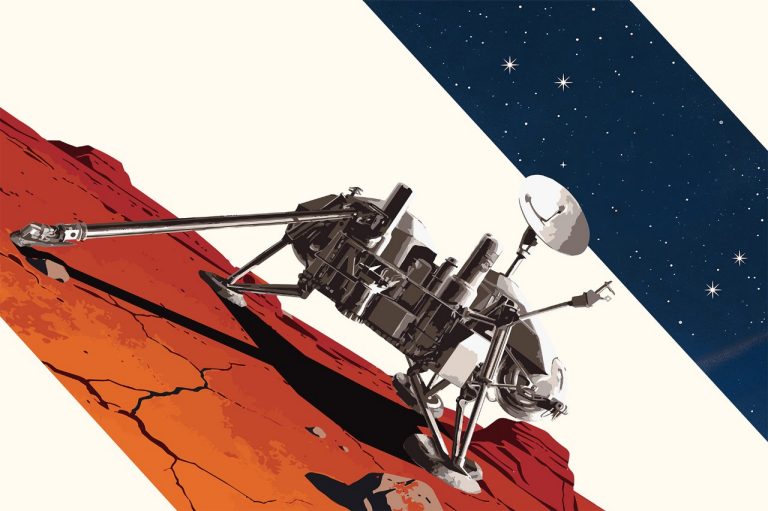

When Viking 1 touched down in Chryse Planitia and returned its first images, it transformed Mars from a distant world into a reachable destination. Just weeks later, Viking 2 landed safely in Utopia Planitia, expanding our understanding of the Red Planet and proving that exploring Mars from the surface was not only possible, but sustainable.
For more than 50 years, Lockheed Martin has supported NASA’s Mars exploration program with spacecraft, systems, mission-critical technologies and flight operations that enable scientific discovery from orbit, on the surface and during entry into the Martian atmosphere. Our legacy spans multiple generations of Mars missions and includes contributions from orbiters and landers to entry, descent and landing (EDL) systems that have collectively advanced humanity’s understanding of the Red Planet.
These missions have helped NASA characterize Mars’ atmosphere, map its surface in high resolution, identify subsurface water ice and study the planet’s interior structure, providing the scientific foundation for future robotic and human exploration.
OUR JOURNEY
AT MARS
From the first U.S. spacecraft to soft-land on the Red Planet to the orbiters, landers and aeroshells flying today, Lockheed Martin has built more Mars spacecraft than anyone else. Below, we highlight 15 programs across five decades. Explore our heritage at Mars using the filters and expand the program cards to learn more.
Reaching the Surface
Successfully reaching the Martian surface remains one of the most challenging objectives in space exploration.
We have developed spacecraft that have enabled critical discoveries from the surface of Mars. The Viking 1 and Viking 2 landers conducted the first long-duration scientific investigations on the Martian surface, analyzing the atmosphere, soil and environmental conditions.
In 2008, the Phoenix mission confirmed the presence of water ice just beneath the Martian surface near the planet's north pole. A decade later, the InSight mission provided the first detailed measurements of the planet's interior structure, using seismic data to study the Martian crust, mantle and core.
These missions have helped answer fundamental questions about the history, evolution and habitability of Mars.
Orbiting the Red Planet
We have designed and built spacecraft that have transformed our understanding of Mars from orbit.
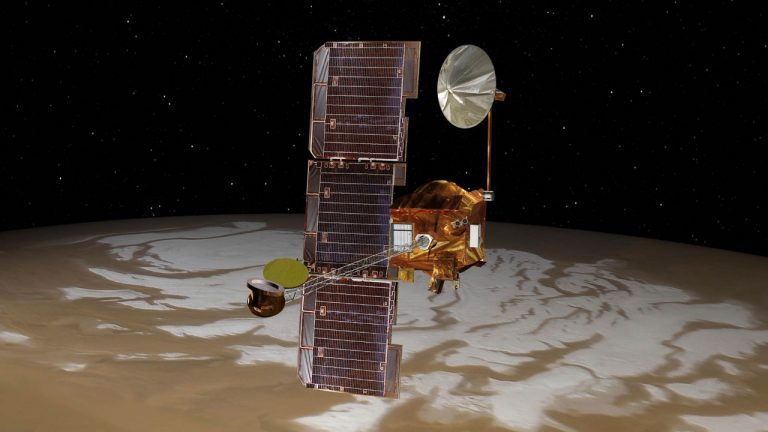
Mars Global Surveyor mapped the planet in unprecedented detail, revealing evidence of ancient water activity and providing foundational data for future missions. 2001 Mars Odyssey identified extensive deposits of subsurface water ice and continues to provide communications relay services for assets operating on and around Mars. And the Mars Reconnaissance Orbiter (MRO) expanded this orbital capability with high-resolution imaging, subsurface sounding and atmospheric observations that have enabled detailed site selection for surface missions and ongoing scientific analysis of Martian geology and climate. Its long-duration operations have made it one of the most valuable assets in NASA’s Mars exploration architecture.
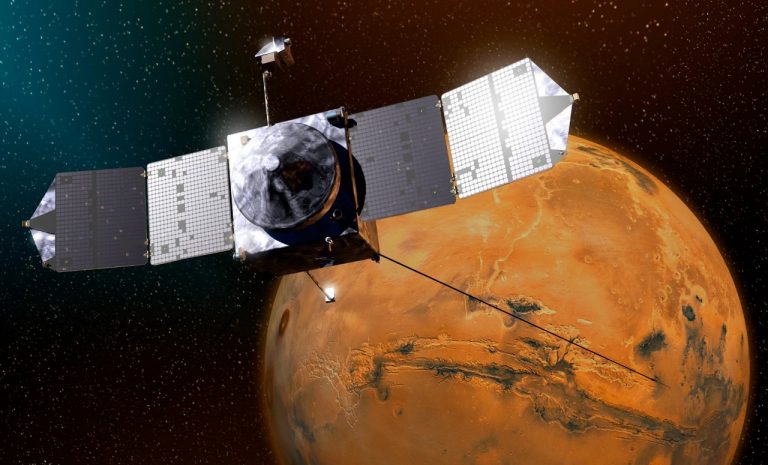
MAVEN (Mars Atmosphere and Volatile Evolution), which studied the Martian upper atmosphere and its interaction with the solar wind, completed its primary science mission and extended operations before concluding its mission. Its data significantly advanced understanding of how Mars lost much of its atmosphere over time and transitioned to its current state.
Together, these orbiters have provided decades of scientific observations while supporting mission operations for NASA’s Mars Relay Network.
Entry, Descent & Landing
Every successful Mars surface mission depends on safely navigating the planet’s atmosphere during entry, descent and landing.
We have extensive experience developing aeroshells and EDL systems that protect spacecraft during the most dynamic phase of Mars arrival. These systems are engineered to withstand extreme thermal and aerodynamic conditions while enabling precise delivery of scientific payloads to the Martian surface.
Our EDL technologies have supported multiple NASA Mars missions and continue to inform future system architectures for planetary exploration.
Mission Operations Center
Our Mission Operations Center (MOC) in Littleton, CO provides continuous flight operations and engineering support for NASA Mars missions, including the Mars Reconnaissance Orbiter (MRO) and Mars Odyssey spacecraft. Teams at the MOC conduct spacecraft health monitoring, flight planning, maneuver design, navigation and real-time operations to sustain long-duration mission performance well beyond primary mission life.
MRO continues to deliver high-resolution imaging and subsurface data that support Mars science and landing site selection, while Mars Odyssey remains the longest-running spacecraft at Mars and provides critical communications relay services for surface assets. Both spacecraft are actively operated from the MOC in coordination with NASA and the Jet Propulsion Laboratory (JPL).
These operations integrate flight controllers, navigation, systems and mission planning teams, enabling continuous command and control of spacecraft millions of miles from Earth while supporting ongoing science and mission extension objectives.